The brain explained
Dementia causes damage to the brain and is not an inevitable part of ageing. Understanding how our brains work can help you understand more about the impacts of different types of dementia.
As we get older, our brain, like every other part of our body gets affected by age and we might slow down in our thinking. It’s important to remember that dementia is not a normal part of this slowing down. Dementia is not an inevitable consequence of ageing. Lorraine Haining, Specialist Dementia Nurse, Dementia Carers Count
Dementia affects the brain
The human brain is a very complex organ which regulates everything we do. Dementia affects the brain and can lead to difficulties in lots of different areas including memory, communication, vision, movement, sensory perception, managing emotions, planning and organising.
Our grey matter
The cerebral cortex is the outermost layer of the brain, otherwise known as grey matter. Although it is only a few millimetres thick, it accounts for about half of the weight of the brain.
The cortex has a folded surface, which, if flattened out, would be much larger than it looks. The folds allow the cortex to accommodate a large surface area in the limited space in the skull. This allows more neurons to be packed into the cortex and maximises the brain’s processing power.
Below the cortex are various sub-cortical structures which are involved in many different complex activities. The cortex is primarily what is affected by dementia.
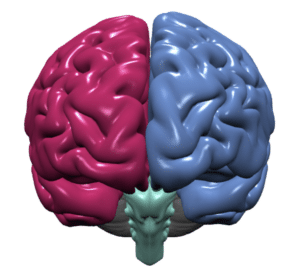
Cerebral cortex
How our brains send and receive information
Neurons – otherwise known as nerve cells – are the cells of the brain. They pass electrical impulses, with the help of chemicals called neurotransmitters, relaying information across the brain and from the brain to the body and back again.
Sections of the brain
Left hemisphere
The left hemisphere tends to be thought of as our ‘computer’ brain, a centre of logic and facts. Most dementias affect the left hemisphere first.
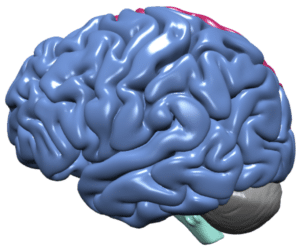
Left hemisphere
Right hemisphere
Our right hemisphere is more about our emotional memories and creative abilities. Right hemisphere skills may be retained for longer.
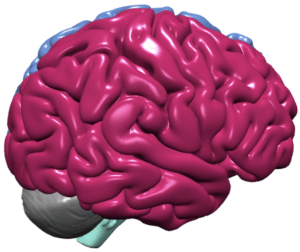
Right hemisphere
Lobes of the brain
Each hemisphere contains four lobes, connected to each other by a superhighway of neurons called the corpus callosum. So altogether we have eight lobes, four on the right and four on the left.
Occipital lobe
The occipital lobe is the primary visual centre and it works in tandem with the eye to help us interpret what the eyes are looking at. The occipital lobe helps us judge distance, speed, depth and controls our field of vision.
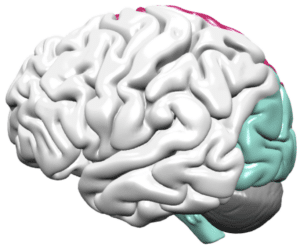
Occipital lobe
Parietal lobe
Next to the occipital lobe lies the parietal lobe, which plays a role in developing reading skills. It’s also the part of the cortex that interprets sensation such as touch, temperature, pain and proprioception or the position of the body in space.
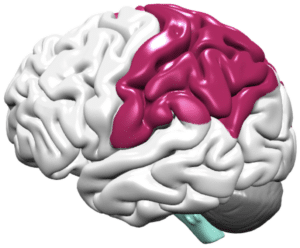
Parietal lobe
Temporal lobe
The temporal lobe contains the primary auditory cortex, which sits at the side next to the ear. This is where the brain makes sense of the sounds the ears capture, such as discerning birdsong from speech. The temporal lobe is heavily involved in understanding language and speaking and is where we store knowledge about objects, for example understanding what a fork is and how it’s used and knowing how it is different from a knife.
Finally, we have one of our memory centres deep in the temporal lobe on the border of the limbic system which we will touch on later. A small structure called the hippocampus, is involved in memory, especially recalling new information but it also helps in reconstructing longer term memories.
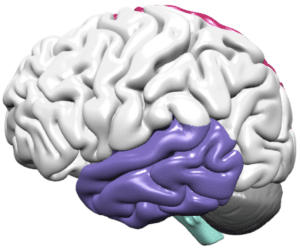
Temporal lobe
Frontal lobe
The frontal lobe has a role in controlling our impulses and social behaviour. It’s what stops us saying out loud what we may be thinking if we know it would hurt someone’s feelings. It also helps us to be empathetic and put ourselves in someone else’s shoes.
The frontal lobe is also our centre of executive functioning. This includes cognitive skills such as planning, organising, problem solving, concentrating, anticipating and reflecting.
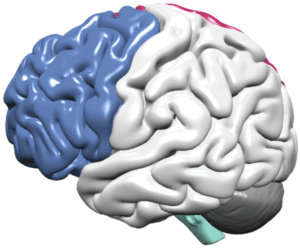
Frontal lobe
Sub-cortical brain
Beneath the cortex lies the limbic system. This is a set of structures in the brain that deals with emotions and memory. The amygdala is also part of the limbic system and is one of the structures in the brain that processes emotion. It also helps us to assess threats, manage fear and drives our ‘fight or flight’ reactions.
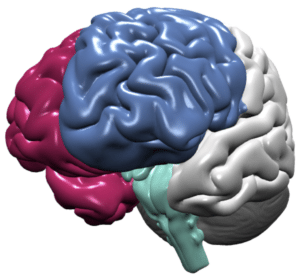
Sub-cortical brain
Read Next
Different types of dementia
There are many different types of dementia. Each can cause different symptoms and behaviours.

How dementia affects memory
Dementia often affects memory. There are things you can do to support the person you care for if they are experiencing memory problems.

Mild cognitive impairment
Mild cognitive impairment affects cognition and people who experience it may have difficulties with memory or thinking.
