Safeguarding Policy

Safeguarding Policy
Safeguarding Policy
| Policy approved by: Board of Trustees | Date of approval: May 2025 |
| Version: 2.0 | Review Date: May 2027 |
Introduction
Dementia Carers Count (DCC) is committed to Safeguarding people in line with national legislation and guidance. We are committed to best safeguarding practice across our operations, and this extends to recognising and reporting harm experienced within the workplace, online, in people’s homes or through our community engagement, partnerships, or wider business activities. DCC is committed to creating a culture of zero-tolerance of harm to everyone who works for, or comes into contact with, the charity.
DCC delivers services through a national Carer Support Line, structured advice and advocacy support (Pathway 1 and Pathway 2), counselling, group programmes, campaigns and a Carers Advisory Panel. Safeguarding considerations arise across all delivery models, including telephone based, online, and partnership delivery. This policy reflects how safeguarding is identified, assessed, and managed within these service contexts.
Policy Statement
DCC believes everyone has the right to live free from abuse or neglect regardless of age, ability or disability, sex, race, religion, ethnic origin, sexual orientation, socio-economic, marital or gender status.
DCC is committed to creating and maintaining a safe and positive environment and an open, listening culture where people feel able to share concerns without fear of retribution.
DCC acknowledges that safeguarding is everybody’s responsibility and is committed to preventing abuse, including neglect through safeguarding the welfare of everyone working with, or connected to, the charity.
DCC recognises that health, well-being, ability, disability and need for care and support can affect a person’s resilience. We recognise that some people experience barriers, for example, to communication in raising concerns or seeking help. We recognise that these factors can vary at different points in people’s lives.
DCC recognises that there is a legal framework within which we need to work to safeguard adults who have needs for care and support and for protecting those who are unable to take action to protect themselves. We will always act in accordance with the relevant safeguarding legislation and follow local statutory safeguarding procedures.
Actions taken by DCC will be will be person centred, proportionate, and led by the individual’s wishes and desired outcomes wherever possible, in line with Making Safeguarding Personal principles. Where this is not possible, decisions will be clearly recorded with rationale. All actions taken will be prompt, proportionate, and consistent with safeguarding principles.
Purpose
The purpose of this policy is to demonstrate the commitment of DCC to safeguarding and to ensure that everyone involved is aware of:
- The legislation, policy, and procedures.
- Their role and responsibility.
- What to do or who to speak to if they have a concern relating to the welfare or wellbeing of an individual within or served by the organisation.
Welfare Concerns vs Safeguarding Concerns
DCC recognises the importance of distinguishing between welfare concerns and safeguarding concerns:
- Welfare concerns may include distress, isolation, or difficulty coping and are addressed through support, monitoring, and internal intervention
- Safeguarding concerns involve suspected abuse, neglect, exploitation, or risk of harm and may require referral to statutory services. Staff are expected to apply professional judgement and seek guidance where needed. Decisions and rationale must be clearly recorded.
Scope
The policy applies to all those connected with the activities of the charity and those who come into contact with DCC including staff, Trustees, Associate Practitioners, Ambassadors, and volunteers. It also applies to all concerns about the safety and welfare of individuals whilst taking part in our organisation, its activities and in the wider community, including working with partner organisations.
Children and Young People
DCC recognises that safeguarding concerns about children and young people might arise in the course of our work with adult carers. DCC recognises its duties to safeguard and protect children and young people in all of its work, as well as adults.
Commitments
- Everyone involved with the charity is aware of the safeguarding procedures to follow and knows what to do and who to contact if they have a concern relating to the welfare or wellbeing of an individual connected to DCC
- Any concern that an individual is not safe is taken seriously, responded to promptly, and followed up in line with DCCs Safeguarding Policy
- The well-being of those at risk of harm will be put first and the individual actively supported to communicate their views and the outcomes they want to achieve
- Any actions taken will respect the rights and dignity of all those involved and be proportionate to the risk of harm
- Confidential, detailed, and accurate records of all safeguarding concerns are maintained and securely stored in line with our Data Protection Policy and Procedures
DCC will cooperate with the Police and the relevant Local Authorities in taking action to
safeguard an individual - DCC will also proactively share with the appropriate bodies (e.g., Disclosure and Barring Services, Police or Social Care) information about anyone considered to be a risk to others
- All Staff, Trustees, Associate Practitioners, Ambassadors and Volunteers understand their role and responsibility for safeguarding individuals and receive training and learning opportunities appropriate for their role. DCC operates a tiered safeguarding training model:
Level 1: All staff and volunteers including trustees Level 2: Frontline staff (CSL, Advice & Advocacy) Level 3: Managers and safeguarding leads Specialist training: Counselling staff (clinical risk and suicide prevention)
- DCC uses safe recruitment practices and will regularly review and improve these to ensure we have the most robust systems in place
- This policy and the associated procedures will be reviewed annually and whenever there are changes in organisational practice or relevant legislation and/or government guidance
Remember
It is always better to err on the side of caution and get it wrong than do nothing and then something happens to that child/adult.
Implementation
Successful implementation of the Safeguarding Policy will, as a minimum, require the following:
- A clear line of accountability within the organisation for the safety and welfare of all individuals.
- Access to relevant legal and professional advice.
- Quarterly safeguarding reports are produced for the Senior Leadership Team and the Board of Trustees.
- Safeguarding procedures that deal effectively with any concerns of abuse or neglect, including those caused through poor practice.
- A clear safeguarding structure including:
- Trustee with Responsibility for Safeguarding
- Strategic Safeguarding Lead (Director of Services)
- Operational Safeguarding Leads (Advice & Advocacy Manager, Counselling Manager)
- Deputy Safeguarding support within service teams
- Risk assessments that specifically include safeguarding.
- Policies and procedures that address the following areas and which are consistent with the Safeguarding approach:
- Bullying and harassment
- Social Media
- Discipline and Grievance
- Concerns, Complaints and Compliments
- Whistleblowing
- Information policy, data protection and information sharing
- Equality, Diversity and Inclusion
Roles and Responsibilities
Safeguarding is the shared responsibility of all individuals involved in DCC including staff, Trustees, Associate Practitioners, Ambassadors, and volunteers.
A Designated Safeguarding Lead (DSL) Deputy DSL (DDSL) and Trustee with Responsibility for Safeguarding will undertake additional responsibilities relating to the overall governance of DCC’s Safeguarding Policy. Descriptors for these roles can be found at Appendix 2 and 3.
Safeguarding Role: Responsible Person
Designated Safeguarding Lead: Director of Services
Deputy Designated Safeguarding Lead: Operational Safeguarding Lead (Advice & Advocacy): Advice & Advocacy Manager Operational Safeguarding Lead (Counselling): Counselling Manager,
Safeguarding Support: Senior Care Support & Advice Officer
Trustee with Responsibility for Safeguarding: Raja Badrakalimuthu
Reporting and Monitoring
Staff and associates must be alerted to safeguarding issues, and any concerns should be shared with the DSL (or deputy) to determine any further action, by following the flowchart set out below
It is the duty of staff to inform only and not to investigate. Responsibility for investigations resides with the lead organisation, which is the relevant Local Authority.
Issues that relate to the protection of adults at risk/children must be prioritised over all other work.
Guidance on managing a Safeguarding concern can be obtained from the DSL for Staff. The Safeguarding Policy sits within the DCC Documents folder on Breathe HR.
All safeguarding concerns must be recorded within DCCs case management system (AdvicePro), ensuring:
- Accurate and timely recording
- Clear audit trail of decisions and actions
- Appropriate access controls for sensitive information
Within a month of any concerns / incidents the DSL will report to SLT and the nominated trustee for safeguarding. The report will highlight the incident(s), recommending any policy and procedural changes and improvements and will also address any staff welfare, safeguarding awareness, and training issues. The report will also be raised at the next board meeting.
In addition, regardless of whether concerns or incidents take place, the DSL for staff will report to SLT and the Board on a quarterly basis. This is to ensure the safeguarding arrangements within DCC are kept under regular review.
If a referral is required to a Local Authority, this will be undertaken in consultation with the DSL, or deputy in their absence. A record of this referral and confirmation of its safe receipt will be recorded and filed confidentially.
Safeguarding concerns in relation to DCC staff, including Trustees, Associate Practitioners, Ambassadors, and volunteers.
Concerns should be reported to the DSL, or deputy in their absence.
In dealing with allegations made against a member of staff, the DSL will discuss this further, in confidence, with a senior HR representative and inform the Chief Executive Officer (CEO).
In the case of the allegation being against the DSL it should be reported to the CEO and in the case of the allegation being against the CEO it should be reported to the Safeguarding Trustee.
Advice will be taken from the appropriate statutory services, alongside legal advice, as to what action should be taken
Safeguarding Decision-making Flowchart
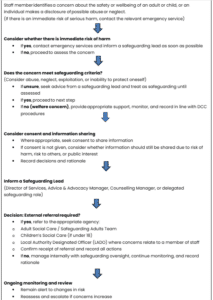
Staff member identifies a concern about the safety or wellbeing of an adult or child, or an individual makes a disclosure of possible abuse or neglect.
(If there is an immediate risk of serious harm, contact the relevant emergency service)
Then:
Consider whether there is immediate risk of harm
- If yes, contact emergency services and inform a safeguarding lead as soon as possible
- If no, proceed to assess the concern
Then:
Does the concern meet safeguarding criteria?
(Consider abuse, neglect, exploitation, or inability to protect oneself)
- If unsure, seek advice from a safeguarding lead and treat as safeguarding until assessed
- If yes, proceed to next step
- If no (welfare concern), provide appropriate support, monitor, and record in line with DCC procedures
Then:
Consider consent and information sharing
- Where appropriate, seek consent to share information
- If consent is not given, consider whether information should still be shared due to risk of harm, risk to others, or public interest
- Record decisions and rationale
Then:
Inform a Safeguarding Lead
(Director of Services, Advice & Advocacy Manager, Counselling Manager, or delegated safeguarding role)
Then:
Decision: External referral required?
- If yes, refer to the appropriate agency:
- Adult Social Care / Safeguarding Adults Team
- Children’s Social Care (if under 18)
- Local Authority Designated Officer (LADO) where concerns relate to a member of staff
- Confirm receipt of referral and record all actions
- If no, manage internally with safeguarding oversight, continue monitoring, and record rationale
Then:
Ongoing monitoring and review
- Remain alert to changes in risk
- Reassess and escalate if concerns increase
Additional considerations (children)
Where concerns relate to a child, staff must seek immediate advice from a safeguarding lead and follow local safeguarding children partnership procedures. Referrals may be made to children’s social care and, where appropriate, the Local Authority Designated Officer (LADO).
Key Principles
- Safeguarding is everyone’s responsibility
- It is the duty of staff to report concerns, not to investigate
- The safety and wellbeing of the individual is paramount
- Actions must be person centred, proportionate, and clearly recorded
- Where in doubt, seek advice and treat as safeguarding
Escalation of Concerns
All staff must be aware that as individuals they are responsible for ensuring any safeguarding concerns are addressed to their satisfaction. If, having spoken to the DSL, an individual feels that their concerns have not been addressed satisfactorily, this should be taken up with the trustee with responsibility for safeguarding.
If the member of staff feels that concerns have still not been addressed then local escalation procedures should be followed. These can be found on the local Safeguarding Children Partnership and Safeguarding Adults Board websites.
Staff are expected to escalate concerns where they feel risk has not been adequately addressed and are supported to challenge decisions in line with DCCs safeguarding culture.
Safeguarding within Service Delivery
Safeguarding may arise across all areas of DCCs work, including direct service delivery, engagement activity, and communications. Staff, volunteers, and representatives must remain alert to safeguarding indicators at all times. Safeguarding considerations apply across the following areas:
Carer Support Line (CSL)
- Initial identification of risk during triage conversations
- Responding to disclosures and assessing immediate risk
Pathway 1 and Pathway 2 Support
- Ongoing identification and monitoring of risk
- Escalation where concerns meet safeguarding thresholds
Counselling Services
- Management of clinical risk, including mental health deterioration, suicide ideation, and emotional distress
- Clear escalation pathways between counselling and wider safeguarding processes
Group Programmes (online and face to face)
- Managing peer disclosures, distress, and group dynamics
- Ensuring safe participation and appropriate boundaries within group settings
Carers Advisory Panel (CAP)
- Recognising that carers contributing to advisory activity may disclose personal experiences of risk or harm
- Ensuring appropriate support, boundaries, and escalation processes are in place where safeguarding concerns arise
Marketing, Communications and Digital Engagement
- Responding appropriately to safeguarding concerns disclosed via social media, email, website forms, or campaigns
- Ensuring clear internal pathways for escalation from non-service delivery teams into safeguarding processes
- Staff must not attempt to manage safeguarding concerns directly through digital channels and must escalate promptly through internal safeguarding processes.
Partnership and External Engagement Activity
- Recognising safeguarding responsibilities when working with partner organisations, attending external meetings, or delivering jointly
- Ensuring concerns are shared appropriately and in line with information sharing protocols
All safeguarding concerns identified through any of the above routes must be recorded and managed in line with DCC safeguarding procedures. Safeguarding responsibility applies equally to staff in non-service delivery roles, including those involved in communications, engagement, and governance functions.
Staff in non-clinical or non-service roles are not expected to assess safeguarding risk but must pass concerns immediately to an appropriate safeguarding lead.
Serious Incident Reporting
DCC will report serious safeguarding incidents in line with Charity Commission requirements. The Director of Services and CEO will determine when an incident meets reporting thresholds.
Appendix 1: Legislation and Statutory Guidance
Key Points
- DCC applies these legislative frameworks proportionately based on the location of the individual being supported.
- There is a legal duty on Local Authorities to provide support to ‘adults at risk’ and to protect children, i.e. anyone under the age of 18, at risk of significant harm.
- Adults at risk are defined in legislation and the criteria applied differs between each home nation (see definitions for each home nation on page 14).
- The safeguarding legislation applies to all forms of abuse that harm a person’s well-being.
- The law provides a framework for good practice in safeguarding that makes the overall well-being of the adult at risk/child a priority of any intervention.
- The law in all four home nations emphasises the importance of person-centred safeguarding
- The law provides a framework for making decisions on behalf of those over the age of 16 who cannot make decisions for themselves (Mental Capacity).
- The law provides a framework for protecting children
- The law provides a framework for all organisations to share information and cooperate to protect adults at risk.
Legislative Framework for Protecting Adults
The practices and procedures within this policy are based on the relevant legislation and government guidance.
- England – The Care Act 2014
Care and Support Statutory Guidance (especially chapter 14) 2014 - Wales – Social Services and Well Being Act 2014
Wales Safeguarding Procedures 2019 - Scotland – Adult Support and Protection Act 2007
Adult Support and Protection (Scotland) Act 2007 Code of Practice 2014 - Northern Ireland – Adult Safeguarding Prevention and Protection in Partnership 2015
Each home nation also has legislation about the circumstances in which decisions can be made on behalf of an adult who is unable to make decisions for themselves:
- England and Wales – Mental Capacity Act 2005
- Scotland – Adults with Incapacity Act 2000
- Mental Capacity (Northern Ireland) 2016
- There are specific offences applying to the mistreatment of and sexual offences against adults who do not have Mental Capacity and specific offences where mistreatment is carried out by a person who is employed as a carer: e.g., wilful neglect and wilful mistreatment.
The Safeguarding Adults legislation creates specific responsibilities on Local Authorities, Health, and the Police to provide additional protection from abuse and neglect to Adults at Risk.
When a Local Authority has reason to believe there is an adult at risk, they have a responsibility to find out more about the situation and decide what actions need to be taken to support the adult. In Scotland and Wales, the Local Authority can gain access to an adult to find out if they are at risk of harm, for example if that access is being blocked by another person.
The actions that need to be taken might be by the Local Authority (usually social care) and/or by other agencies, for example the Police and Health. The Local Authority role includes having multi-agency procedures which coordinate the actions taken by different organisations.
Legal Definitions of an Adult at Risk
England (Care Act 2014): An adult at risk is an individual aged 18 years and over who:
(a) has needs for care and support (whether the local authority is meeting any of those
needs) and;
(b) is experiencing, or at risk of, abuse or neglect, and;
(c) because of those care and support needs is unable to protect themselves from either the risk of, or the experience of abuse or neglect.
Northern Ireland (Adult Safeguarding Prevention and Protection in Partnership 2015): An adult at risk of harm is a person aged 18 or over, whose exposure to harm through abuse, exploitation or neglect may be increased by their a) personal characteristics and/or b) life circumstances.
a) Personal characteristics may include, but are not limited to age, disability, special
educational needs, illness, mental or physical frailty or impairment of, or disturbance in, the functioning of the mind. or brain.
b) Life circumstances may include, but are not limited to, isolation, socio-economic
factors, and environmental living conditions.
An adult in need of protection is a person aged 18 or over, whose exposure to harm through abuse, exploitation or neglect may be increased by their personal characteristics and/or Life circumstances and;
c) who is unable to protect their own wellbeing, property, assets, rights, or other
interests; and;
d) where the action or inaction of another person or persons is causing, or is likely to
cause, him/her to be harmed.
Scotland (Adult Support and Protection Act 2007): An adult at risk is an individual aged 16 years and over who:
a) is unable to safeguard their own well-being, property, rights, or other interests, and;
b) is at risk of harm, and;
c) because they are affected by disability, mental disorder, illness or physical or mental infirmity, is more vulnerable to being harmed than adults who are not so affected.
Wales (Social Services and Well Being Act 2014): An adult at risk is an individual aged 18 years and over who:
a) is experiencing or is at risk of abuse or neglect, and;
b) has needs for care and support (whether the authority is meeting any of those
needs), and;
c) because of those needs is unable to protect himself or herself against the abuse or
neglect or the risk of it.
In relation to children and young people DCC will follow local multi-agency procedures to protect children and young people, which are published on the Local Safeguarding Children Partnership website for each Council.
Appendix 2: Role Descriptor for DSL and Deputy DSL
The DSL and deputy have responsibility for co-creating and managing procedures, commissioning training, reviewing and improving policy, and regularly reporting to the Senior Leadership Team and Board.
Specific duties and responsibilities include:
- Working with others within the organisation to create a positive, safe and inclusive
environment. - Play a lead role in developing and establishing the organisation’s approach to safeguarding individuals and in maintaining and reviewing the organisation’s implementation plan for safeguarding in line with current legislation and best practice.
- Coordinate the dissemination of the safeguarding policy, procedures and resources throughout the organisation.
- Contribute to ensuring other policies and procedures are consistent with the organisation’s commitment to safeguarding adults.
- Advise on the organisation’s training needs and the development of its training strategy.
- Produce quarterly safeguarding reports for the Senior Leadership Team and the Board of
Trustees. - Manage liaison with, and referrals to, external agencies, including social care services and the police.
- Be the central point of contact for internal and external individuals and agencies, in relation to safeguarding.
- Represent the organisation at external meetings related to safeguarding
Appendix 3: Role Descriptor for Trustee with Responsibility for Safeguarding
DCC recognises that all trustees are responsible for safeguarding but has chosen to nominate a specific safeguarding trustee. The safeguarding trustee will ensure safeguarding is properly reflected in strategy, policy and practice and that DCC creates a safe and supportive culture.
Specific duties and responsibilities include:
- Ensuring DCCs strategic plans reflect safeguarding legislation and the expectations of the Charity Commission.
- Working with the CEO, DSL and deputy to review progress and identify improvements to
policy and practice. - Making sure safeguarding has space on the Board agenda and trustees understand and
challenge reports. - Ensuring Safeguarding Annual Reviews are undertaken, and reports are produced for Board.
- Overseeing safeguarding allegations against staff and volunteers with CEO and DSL.
- Being a point of contact for staff or volunteers if someone wishes to raise a concern about a lack of action in relation to safeguarding concerns.
- Support trustees in developing their individual and collective understanding of safeguarding.
- Attend relevant meetings with staff and volunteers to understand safeguarding in practice at DCC.